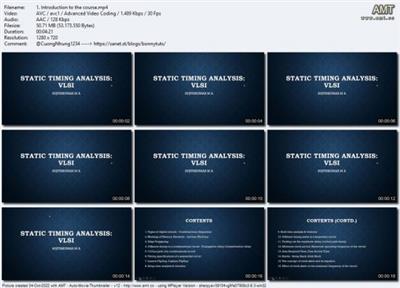
 Static Timing Analysis: VLSI
Published 10/2022
MP4 | Video: h264, 1280x720 | Audio: AAC, 44.1 KHz, 2 Ch
Genre: eLearning | Language: English | Duration: 18 lectures (2h 21m) | Size: 826.3 MB
Learn the timing parameters and design a circuit that will meet the timing requirements
What you'll learnPerform Static Timing Analysis on a digital circuit
Figuring out the maximum operating frequency of any sequential circuit
Identify the timing violations and mitigate them
Identify all the timing paths in a circuit
RequirementsNo, But a basic knowledge in Digital Electronics will help!
DescriptionWant to become a chip design engineer? Then, STA is mandatory for you!
Welcome to my course on 'Static Timing Analysis on VLSI Circuits'
This course will help you to design a digital circuit meeting all the timing constraints given.
The contents that we will be discussing in this course are
1. Types of digital circuits - Combinational, Sequential
2. Working of Memory Elements - Latches, Flipflops
3. Edge Triggering
4. Different delays in a combinational circuit - Propagation delay, Contamination delay
5. Critical path of a combinational circuit
6. Timing specifications of a sequential circuit
7. Launch Flipflop, Capture Flipflop
8. Setup time analysis & violation
9. Hold time analysis & violation
10. Different timing paths in a sequential circuit
11. Finding out the maximum delay (critical path delay)
12. Minimum clock period, Maximum operating frequency of the circuit
13. Data Required Time, Data Arrival Time
14. Slacks - Setup Slack, Hold Slack.
15. The concept of clock skew and its equation
16. Effect of clock skew on the maximum frequency of the circuit.
After understanding the concepts and the equations, Some example problems and interview questions will be solved in the last section.
A clock signal is used by sequential circuits to regulate the flow of system data. The maximum clock frequency that can be employed in the circuit can be calculated from a set of combinational and sequential components and the timing parameters that go with them. In this study, each flip-flop to flip-flop path in the circuit is looked at. Both the data setup time at the destination flip-flop and the propagation delays throughout the pathways are examined. Each flip-flop to flip-flop path can be checked to see if flip-flop hold times are satisfied after figuring out the maximum clock frequency. The circuit will function as intended if the contamination delays along each path are more than or equal to the target flip flop hold time.
Who this course is forBeginner VLSI Design Aspirants
Anyone who wants to design ASIC
Download linkrapidgator.net:
https://rapidgator.net/file/03dcfc9ca22e4c413f1d2985cd45e3a9/ktdve.Static.Timing.Analysis.VLSI.rar.html
uploadgig.com:
https://uploadgig.com/file/download/D4e743bca3B7fCC2/ktdve.Static.Timing.Analysis.VLSI.rar
nitroflare.com:
https://nitroflare.com/view/ABACAFB409B7734/ktdve.Static.Timing.Analysis.VLSI.rar
1dl.net:
https://1dl.net/6yz55cf3gmw5/ktdve.Static.Timing.Analysis.VLSI.rar.html

 Cantinho Satkeys
