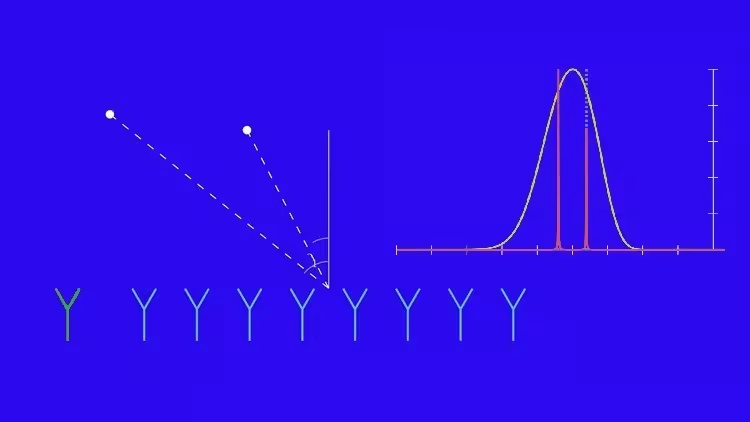
 Free Download Multiple Signal Classification (MUSIC) for DoA
Published 1/2026
MP4 |
Video: h264, 1920x1080 |
Audio: AAC, 44.1 KHz, 2 Ch
Language: English |
Duration: 1h 12m |
Size: 810 MB
Understand the MUSIC algorithm for DoA through phased arrays, covariance analysis, and fixed-point modeling
Understand the MUSIC algorithm and its processing stages for direction-of-arrival estimation
Model MUSIC processing blocks using fixed-point arithmetic and analyze quantization effects
Evaluate precision-performance trade-offs in fixed-point signal processing implementations
Validate fixed-point models against floating-point reference implementations
Prepare fixed-point models for later FPGA and HLS-based implementation
RequirementsBasic knowledge of digital signal processing and linear algebra is recommended. Familiarity with Python is required.
DescriptionThe Multiple Signal Classification (MUSIC) algorithm is one of the most powerful and widely used techniques for high-resolution Direction-of-Arrival (DoA) estimation in array signal processing. Despite its popularity, many engineers struggle to move beyond formulas and truly understand how the algorithm behaves in practice-especially when preparing it for efficient hardware implementation.This course focuses on building a clear, structured understanding of the MUSIC algorithm, starting from phased array fundamentals and progressing through the full signal processing workflow. Rather than treating the algorithm as a black box, the course explains each processing stage and highlights the practical considerations that arise in real systems.A major emphasis is placed on fixed-point modeling, which is a critical step when preparing signal processing algorithms for FPGA or embedded deployment. You will learn how covariance computation, eigenvalue decomposition using Jacobi rotations, CORDIC-based angle computation, and pseudospectrum evaluation behave under finite precision constraints. Python-based models are used to analyze numerical accuracy, scaling, and precision-performance trade-offs.The course is designed for engineers who want to bridge the gap between theory and implementation. While no FPGA coding is required in this course, the material is structured to prepare you for hardware-oriented workflows, making it an ideal foundation for later FPGA or HLS-based implementations.By the end of the course, you will not only understand how MUSIC works, but also how to model, analyze, and validate it under realistic fixed-point constraints-an essential skill for modern signal processing and radar systems.
Who this course is forEngineers and researchers working with array signal processing or radar systems
FPGA and embedded systems engineers who want to understand fixed-point DSP modeling
Students and practitioners interested in implementing signal processing algorithms on hardware
Developers preparing for FPGA or HLS-based implementation of advanced DSP algorithms
This course is not intended for absolute beginners without DSP or programming background
Homepagehttps://www.udemy.com/course/music-for-doa/Recommend Download Link Hight Speed | Please Say Thanks Keep Topic Live
No Password - Links are Interchangeable

 Cantinho Satkeys
