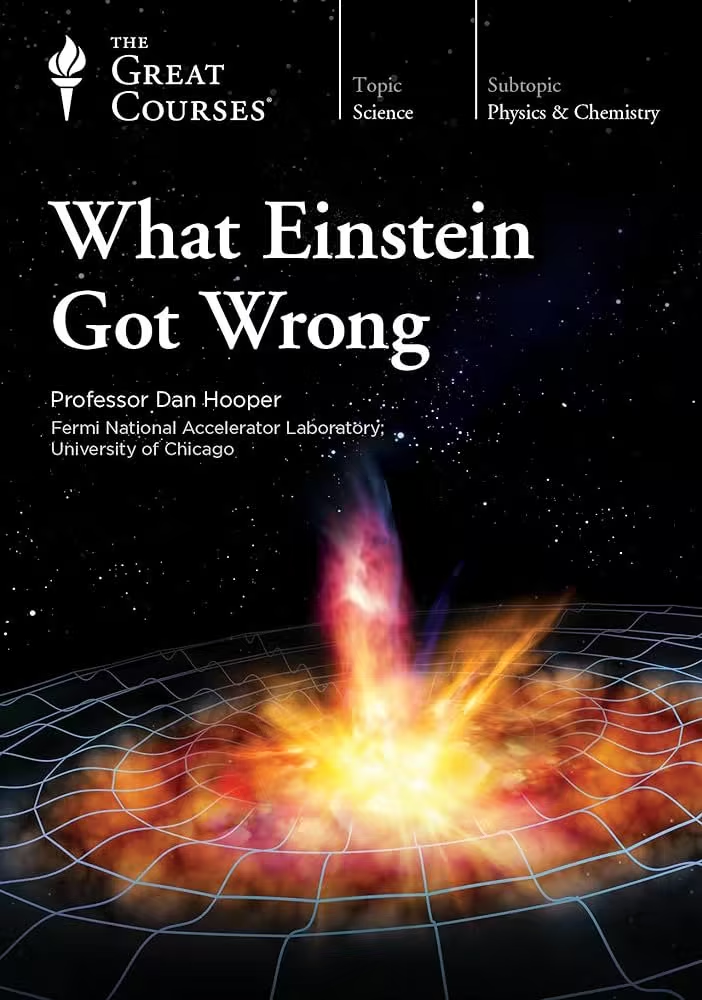
 Free Download The Great Courses - What Einstein Got Wrong
MKV |
Video: h264, 1280x720 |
Audio: AAC, 44.1 KHz
Language: English |
Size: 5.89 GB |
Duration: 5h 45m
He was the quintessential genius whose brainpower rewrote the laws of the universe. Albert Einstein may have died decades ago, but his immense legacy continues. Who has not heard of Einstein's theory of relativity, which revolutionized our understanding of space, time, and matter? His other discoveries are themselves titanic achievements that on their own would have made him a famous scientist.
But Einstein was not infallible. He rejected the possibility of black holes, and he was reluctant to accept the concept of an expanding universe or that gravity waves might exist. All are predicted by his general theory of relativity, and all have been well confirmed by observations. Furthermore, he was practically alone among his peers in resisting the startling implications of quantum mechanics-a theory that he helped found and whose strange picture of reality has been verified in experiment after experiment.
In other words, what Einstein got wrong includes some of the most exciting science of our time.
In a course aimed at the scientifically curious at all levels, What Einstein Got Wrong focuses on the great scientist's mistakes as a window into his mind-his thought processes, prejudices, and philosophical outlook. Studying Einstein's errors may well be the best way of getting inside the head of this incomparable and enigmatic thinker, who was so influential that Time magazine named him the Person of the Century in 1999.
Your professor on this thrilling intellectual journey is Dr. Dan Hooper, a researcher at the forefront of physics and a popular author and speaker on particle physics and cosmology. Dr. Hooper is Senior Scientist at the Fermi National Accelerator Laboratory, and Associate Professor of Astronomy and Astrophysics at the University of Chicago.
In twelve half-hour lectures, Dr. Hooper discusses Einstein's ideas-right and wrong-using minimal mathematics, so it's accessible to curious minds everywhere. Those new to Einstein's ideas will find What Einstein Got Wrong an excellent survey of the full scope of the master's work, while those more experienced with physics and relativity will relish Dr. Hooper's insights into Einstein's legacy in modern physics, which lives on in myriad ways. Even Einstein's mistakes inspired others along productive paths.
Einstein Invents Relativity but Doesn't Fully Buy It
You begin with a two-lecture review of what Einstein got spectacularly right, notably his special and general theories of relativity. Proposed in 1905, special relativity introduced such concepts as the constancy of the speed of light, the relativity of simultaneity, time dilation, and the equivalence of mass and energy. General relativity, published a decade later, greatly enlarged the scope of special relativity by incorporating gravity, which Einstein showed is a geometric property of space and time.
Special relativity created a sensation among Einstein's fellow scientists, but general relativity made him world-famous, giving him a reputation as a scientific magician. That reputation stuck, and only his colleagues appreciated the setbacks that dogged him throughout his career as he struggled to develop and interpret his theories
The relativity race: Einstein had the conceptual pieces of general relativity in place long before he worked out the mathematical details. Unwittingly abandoning a promising path to a definitive theory, he suddenly discovered he was in a race with the world's foremost mathematician, who was working on his own formulation of general relativity. Einstein barely won.
Black holes banned: The first meaningful solution to Einstein's equations of general relativity were worked out by mathematician Karl Schwarzschild, whose calculations showed the possibility of infinitely dense objects, later dubbed black holes. Einstein held that natural forces would prevent such bizarre phenomena, and his influence long persuaded other physicists that black holes were impossible.
His "biggest blunder": Convinced that the universe is static and eternal, Einstein added a cosmological constant to his formula for general relativity to forestall the instability his theory predicted. When astronomer Edwin Hubble discovered that the universe is expanding-that is, it's unstable-Einstein reportedly called the constant his "biggest blunder."
Einstein Fights the Quantum Revolution
Along with relativity, the other great revolution in physics in the 20th century was quantum mechanics. Einstein led the way here too, by proving the particle nature of light and that atoms really exist. As with relativity, he was wary of accepting the full implications of the developing theory
"God does not play dice": Experiments showed that matter behaves very strangely at the quantum scale. Einstein's friend Max Born proposed that the traditional view of cause and effect does not apply in quantum mechanics, where interactions can only be understood in terms of probabilities. Einstein dismissed this view with the remark, "God does not play dice with the universe."
Schrödinger's cat: Working with colleagues Boris Podolsky and Nathan Rosen, Einstein devised a thought experiment that showed an apparent impossibility in a quantum state later called entanglement. This was the inspiration for Erwin Schrödinger's famous paradox involving a cat that is simultaneously dead and alive. But impossible or not, entanglement turns out to be real.
Unified field theory: Inspired by James Clerk Maxwell's unification of electrical and magnetic phenomena in a single theory called electromagnetism, Einstein sought to do the same for electromagnetism and relativity. His hope was that this "unified field theory" would restore determinism and scientific realism to the quantum world. But his labors were fruitless.
Dr. Hooper stresses that Einstein's miscalculations, oversights, and false leads do not detract from his greatness. In the final lecture, he points out how missteps also plagued the careers of Johannes Kepler, Galileo Galilei, and Isaac Newton-three other indisputable giants in the history of science.
Indeed, mistakes are fundamental to scientific progress. One of Einstein's colleagues at Princeton University, the physicist John Wheeler, observed that "our whole problem is to make mistakes as fast possible." Only by priming the pump with theories that can be tested against evidence do we advance closer to the truth, throwing out the bad theories and improving the good. The beauty of science is not that it is infallible but that it corrects its mistakes. Einstein was a ceaselessly creative participant in this process, as you learn in What Einstein Got Wrong.
Homepagehttps://shop.thegreatcourses.com/what-einstein-got-wrongRecommend Download Link Hight Speed | Please Say Thanks Keep Topic Live
No Password - Links are Interchangeable

 Cantinho Satkeys
