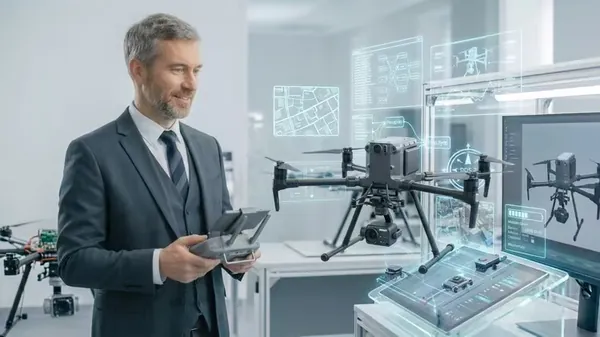
 Drone & Autonomous Systems 100 Labs with ROS 2 & PX4
Published 7/2026
MP4 |
Video: h264, 1920x1080 |
Audio: AAC, 44.1 KHz, 2 Ch
Language: English |
Duration: 7h 40m |
Size: 1 GB
From zero robotics knowledge to architecting production-grade autonomous drone fleets with ROS 2, PX4, Edge AI & Cloud.
What you'll learnArchitect complete autonomous drone systems using modern robotics engineering principles instead of isolated scripts.
Master ROS 2, PX4, simulation workflows, robotics middleware, and distributed autonomous system design.
Design reliable flight-control architectures including PID concepts, navigation pipelines, fail-safe logic, and autonomous behaviors.
Build perception pipelines using Computer Vision, sensor fusion, SLAM fundamentals, and real-time object detection.
Deploy Edge AI workloads capable of making real-time autonomous decisions without relying entirely on cloud infrastructure.
Engineer secure drone communication systems using telemetry, MAVLink concepts, encryption, fleet networking, and cloud integration.
Scale from a single autonomous drone to coordinated multi-drone fleet orchestration with fault tolerance and mission scheduling.
Implement compliance-aware autonomous systems including audit logging, geofencing, security controls, and explainable AI workflows.
Operate production-style deployment pipelines with observability, CI/CD, monitoring, disaster recovery, and performance optimization.
Complete a PhD-style capstone by designing and simulating a fully autonomous drone fleet intelligence platform suitable for real-world industrial scenarios.
RequirementsStudents should have
- Basic computer literacy
- Curiosity about robotics, drones, AI, or autonomous systems
- No prior robotics experience required
Recommended software
- Ubuntu 24.04 LTS (or newer)
- Visual Studio Code
- Docker Desktop (optional but recommended)
- Git
DescriptionThis course contains the use of artificial intelligence.
I only charge a fee solely for the time invested in building this comprehensive curriculum.
Engineering Autonomous Systems Instead of Just "Vibe Coding"
The drone industry has changed dramatically.
Today, almost anyone can watch a few online videos and make a drone fly inside a simulator. Large language models can even generate pieces of robotics code with a single prompt.
But building
production-grade autonomous systems is an entirely different challenge.
Professional engineers don't simply make a drone fly.
They build systems that continue operating when GPS becomes unreliable.
They design architectures that recover from failures.
They create communication pipelines that remain secure.
They build autonomous fleets capable of making safe decisions while complying with operational rules and regulatory constraints.
That difference is what this course is about.
This is not another tutorial series focused on isolated commands or copy-paste examples.
It is a complete engineering specialization built around
100 carefully structured laboratories that progressively transform your thinking-from understanding a single autonomous component to architecting complete intelligent drone ecosystems.
Why This Course Is Different
Every lab follows the same engineering philosophy
- Understand the architecture
- Learn why systems work
- Build the solution
- Verify the result
- Troubleshoot real engineering problems
- Prepare for production deployment
Instead of memorizing commands, you will develop the mindset required to engineer autonomous systems that are reliable, scalable, observable, and maintainable.
By the end of the journey, you won't just know individual technologies-you'll understand how they fit together into one cohesive production platform.
What's Inside the 100 Labs?
The curriculum progresses like a real engineering career.
You begin with robotics thinking, Linux, Python, embedded systems, sensors, control theory, communication, and safety fundamentals.
Next, you'll move into ROS 2 architecture, distributed robotics middleware, simulation-first development, telemetry, coordinate systems, debugging, and autonomous testing.
You'll then learn flight dynamics, navigation, PID concepts, autonomous flight modes, emergency recovery systems, and waypoint navigation.
The course continues into computer vision, perception pipelines, optical flow, SLAM concepts, environment mapping, and vision-driven navigation.
After perception comes communication engineering-MAVLink concepts, secure telemetry, networking, edge communication, cloud telemetry, and fleet messaging.
You'll then build intelligent decision systems using Edge AI, onboard inference, adaptive navigation, sensor fusion, reinforcement learning concepts, and resilient failover architectures.
Scaling from one drone to many, you'll design fleet orchestration, swarm coordination, distributed mission assignment, fault tolerance, telemetry aggregation, and fleet security.
Security and governance become first-class engineering concerns as you implement compliance workflows, geofencing, audit trails, identity management, encrypted communication, and explainable autonomous decision-making.
Finally, you'll explore production deployment practices including cloud integration, CI/CD, monitoring, observability, disaster recovery, performance optimization, and simulation-to-real deployment strategies.
The Ultimate Goal: Lab 100
Everything builds toward a single engineering challenge.
Lab 100 is not a toy project.It is a complete autonomous drone fleet intelligence platform.
You'll architect and simulate a production-style ecosystem featuring
- Distributed ROS 2 communication
- Multi-drone fleet coordination
- Autonomous navigation
- Edge AI decision making
- Real-time perception
- Secure telemetry
- Cloud monitoring
- Compliance-aware governance
- Fault tolerance
- Fleet orchestration
- Production observability
This capstone reflects the type of systems found in infrastructure inspection, environmental monitoring, industrial automation, research laboratories, and next-generation autonomous operations.
Completing it demonstrates that you can reason about autonomous systems as integrated engineering platforms-not isolated software components.
Why Enroll Today?
Autonomous systems are no longer experimental.
Organizations increasingly need engineers who understand robotics, cloud computing, distributed systems, AI, networking, observability, security, and compliance as one connected discipline.
This course gives you that integrated perspective through 100 production-focused labs.
If your goal is to move beyond tutorials and develop the engineering mindset required to build reliable autonomous systems, this course provides a structured path from fundamentals to advanced system architecture.
Your journey starts with a single system diagram.
It ends with an autonomous fleet.
Who this course is for1. The Future Robotics & AI Engineer
You want to build intelligent autonomous systems instead of merely learning robotics theory. You want production-grade engineering skills that employers actually value.
2. The Drone Developer or Embedded Engineer
You already understand programming or electronics and now want to move into ROS 2, PX4, autonomous navigation, Edge AI, and fleet-scale drone architectures.
3. The Senior Software/Cloud/DevOps Engineer
You already build distributed systems and want to expand into autonomous robotics, cloud robotics, fleet orchestration, simulation-first engineering, and production deployment pipelines.
Recommend Download Link Hight Speed | Please Say Thanks Keep Topic Live
No Password - Links are Interchangeable

 Cantinho Satkeys
